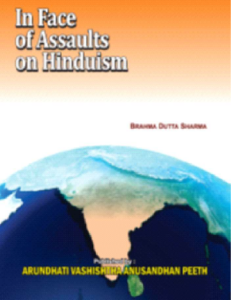
Prayagraj: Arundhati Vashishtha Peeth, 2019, pp. viii + 157, PB, Price: 200, ISBN: 978-81-931312-8-2.
Reviewed by Prakash Joshi
Let us meditate on OM the
imperishable, the beginning of
prayer. For as the earth comes
from the waters, plants from earth,
and man from plants, so man is
speech, and speech is OM. Of all
speech the essence is the Rig
Veda; but Sama is the essence of
Rig, and of Sama the essence is
OM, the Udgitha.
Thus translates Eknath Easwaran the two opening verses of Chhandogya Upanishad explaining the immensity of OM, the ultimate prayer (125). If we look at In Face of Assault on Hinduism as a novel, as the author and the first person narrator, Prof. Brahma Dutta Sharma chooses to describe it in the author‘s Preface, the major question, the answer to which we must find later or sooner, would be the question about the theme of the novel. Since the novel is most ostensibly the narrative of the protagonist’s experiences of working in the West Asian Islamic country of Yemen for a period of around seven years from 2008 to 2015, the theme would naturally be lodged in those experiences. And since the narrated experiences chiefly speak of the protagonist’s living and working in a land with a culture vastly different from his own, the theme would very likely be found in the situations that portray the irreconcilable differences between the two cultures. As such, the theme of the novel, visible on the surface of the narrative in some chapters and running subterranean in some others, is the fact that the protagonist eventually comes out as a survivor of the ‘assault’ that the title mentions, and thereby proves himself an admirable saviour of his own faith by drawing his strength from his God whom he names as ‘Om’ – the faceless, the formless and the Omnipresent Supreme Soul ceaselessly and forever incarnating Himself in His Creation.
Interestingly enough, the two points enclosing the entire narrative — the point of the first departure of the protagonist to Yemen and the point of the final return — are both marked and marred by violence. While the first of these two was the unleashing of the terror attack by Pakistani terrorists on the Taj Hotel of Mumbai in November 2008, which the narrator talks of in Chapter Two, the second, in 2016, is the armed conflict in Yemen for the political control of the country. It is this conflict, aided and abetted by Saudi Arabia and its allies in and outside the Middle East, which the narrator talks of in the last chapter as the sole cause and reason of his sudden and final return to India.
As is stated earlier and as it gets highlighted in its title, the novel tells the story of the protagonist‘s coming out a survivor of the assaults on his faith. There are several occasions in which the protagonist finds himself trying hard to explain the tenets of his faith and the associated cultural beliefs and rituals to a set of people who would find those beliefs and rituals quaint and sometimes even low. The very first chapter, for example, is an interesting portrayal of how the protagonist, who is a professor of English in Yemen, defends and explains the logic of the Hindu way of disposing off their dead relatives and the related rites. Instead of ducking or dismissing or feeling intimidated by the deprecatingly asked questions by a student about what he thought was the insensitivity involved in the practice of consigning the bodies of dead humans to fire, the professor patiently explains the ecological rationality and hygienic sense of the Hindu way of burning their dead to ashes. In another situation, which comes up in the fifth chapter, the protagonist is seen logically defending his vegetarianism when confronted by the local, non-vegetarian Yemenis quoting their scriptural belief
that all things in nature, including animals, have been created by the Almighty for human beings to consume, meaning thereby that animals should be treated as food by humans (27). The protagonist is at one of his best using logic and citing the common laws of nature to point out the many anomalies in the questioner’s argument. Like the one who has feelings for all creatures in nature, the protagonist also tells the questioner that human beings are human beings chiefly because they have a moral sense and can distinguish between what should be done and what should notbe done (29). As one goes through the chapter, one begins to see the irony in the fact that the protagonist has to go to such lengths of arguments and debates to defend his non-violent eating habits.
As he does in the case of explaining the rationale and the logic and the sense in his vegetarianism, the protagonist is once again at his best in explicating the differentiation between ‘Ishwar’ and ‘Devatas’ in the Hindu faith. In our language we have the word ‘Ishwar’ for the Supreme Being and the word ‘devata’ for benefactors, he perceptibly and concisely points out to the person who questions him about the Hindu belief in the sacredness of cow (84). His explication means much because it is characterized by the spirit of accommodation and inclusion, not of exclusion: the spirit that gets a further illustration in his compassionate description of the reasons why many people of his faith practise idolatry. The reasons, he says in Chapter Eighteen, are embedded in the human nature that not only includes sentimentality but also makes humans like to see their beliefs visually represented. While talking to another person in another chapter, Chapter Twenty Eight, he briefly explains the iconography and the symbolism of the images of the popularly worshipped gods in India. Chapter Twenty Seven and Chapter Thirty are quite interesting in thesense that they show the protagonist negotiating the situations in which some people want him to convert to Islam. In the former of the two, an evangelically enthusiastic person tells him that he would have an unending happiness living in Jannat if he converted. The protagonist, however, logically questions the very concept of Jannat and also questions the idea of undergoing austerities in this life in this world just in order to enjoy luxuries in the afterlife in another place. His logic is impeccable when he says, If something is bad for man in this life, it must be bad for him in Jannat too (125). The latter chapter, thirtieth, turns quite dramatic and even amusing when a couple of people ask the protagonist to recite the Kalma, which he does without any inhibitions. When asked afterwards if he had become a Muslim, he replies that he hadn‘t. Perhaps, the people who had asked him to recite the Kalma had hoped for some miraculous change in his faith, and were disappointed to learn that he had still remained firm in his own faith in ‘Om.’
Interspersed through the novel are the experiences of the protagonist that narrate his encounter with situations in which he has to bribe people to get routine things done, has to learn cooking in order to be sure that he would only be eating vegetarian food, has to encounter opposition to his administration of his department as its administrative head, has to face circumstances in which he is expected to give undue advantage to some politically well-connected people, and also has to go through a harrowing experience of just escaping being mugged by a gang of thugs. Of course, the narrator-protagonist also has a few happy experiences of meeting empathetic and open-minded people; but these are outdone by the experiences of the other kind.
Of the narrations not directly related to the thematic bent of the novel, there is one that needs special mention. And that is the narration in the last chapter of the 156 Ars Artium, Vol. 12, January 2024 sudden outbreak of the war in Yemen, which has continued to date and has caused an unmentionable amount of misery to the Yemenis. The world has heard of the starvation deaths in Yemen, has seen visuals of people shrunken to their bones due to starvation, yet there is no apparent likelihood of relief reaching there because of the Saudi Arabia’s bombarding Yemeni territories almost non-stop since 2015. What has worsened the situation for Yemenis is the long stretch of famine since 2016, which according to several media reports has put around 13 million people of the country at the risk of starvation death. The crisis there, as the last chapter briefly points out, was started off by the attempt of the Houthis, to take over the country. While the sect has the support of Iran, Saudi Arabia does not like it. Long drawn the conflict in Yemen may be, it still doesn’t seem anywhere near the end. The NewYork Times of 18 July 2019 has explained the reason of this crisis. (Kirkpatrick)
Reading the novel can be a lesson and a learning experience in many ways. One, the reader may learn about why and how to be positively but openly convinced about his or her belief systems. Two, he or she may learn how to work in an alien land of unfamiliar people and also learn how to invite minimum trouble by limiting oneself to his or her work area only. Three, he or she may learn how one can negotiate with even a very antagonistic atmosphere by being rational and upright and just. At some other level, the novel confirms the belief that human nature remains the same whatever the culture and whatever the place.
While the narrative itself reads more like a memoir, the Preface carries its message, not in the form of preaching or a prescription but in the form of a conclusion drawn from a series of experiences of more or less the same nature. And that message speaks of the need for the society to accept diversity in order to reach the stage and state of peaceful co-existence (v). The foregrounding of the message, by virtue of its unambiguous placement in the Preface, casts a guiding light on the narrative to follow and, simultaneously, sums up the essence of the experiences of the protagonist.