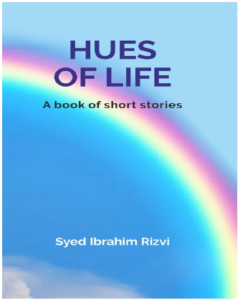
New Delhi: GenNext Publication, 2023, pp. 104, PB, Price: 180, ISBN: 978-93-5663-947-8.
Reviewed by Pradeep Kumar
Syed Ibrahim Rizvi is a Professor of Biotechnology at University of Allahabad, India. Though he is an erudite scholar of science, yet he is always enthusiastic about literature and keeps himself busy in observing life minutely and puts his experience in words. As a result, in a very short time, he has become a popular story-teller who entertains his readers by his interesting short-stories.
Listening to stories is always bliss. During our childhood we used to listen to stories from our parents and grandparents and we felt overwhelmed by the way they used to describe the things in a dramatic way. Today we have lost that tradition due to the excessive use of mobile phones and other multimedia. The latest book of Prof. Rizvi gives some hope to the story-lovers because after reading the stories of this book they are sure to go back into their childhood days.
After his two successful publications, Kaleidoscope of Thoughts (2020) and A Tryst with Emotions (2022), Prof. Rizvi came up with his third book Hues of Life: A Book of Short Stories which is a collection of seven short stories. The title of the book is very striking and it justifies its contents because all the seven stories represent the various colours of human life. All the stories of this book are based on the campus of University of Allahabad because the characters of the stories first appear in the campus. So, it would not be wrong to call this book a Campus Fiction.
The stories of this book are full of romances, ups and downs of human life, and all the stuffs that are common in a normal life. When a reader goes through these stories he feels like he is watching some TV serial or a movie. The minute descriptions of the surroundings, inner thoughts of the characters, cultural and religious beliefs of the characters are beautifully presented by the author. The story “Of Black Tuxedo and Maroon Sari” is a story of a couple who love each other but destiny doesn’t allow them to go ahead with their plans. In this story, the author describes the transformation of a female character Sumaira who feels shy and is stuck to her culture and religion but at later stage she falls in love with a boy named Javed. One day Sumaira gets pregnant. Prof. Rizvi represents this incident without using any obscene words. He simply says:
The brief visit to the room ostensibly to fetch a jacket took approximately forty minutes. She emerged from the room with a look which portrayed an expression of guilt. Sumaira’s hair was disheveled and her appearance pale. Silently she took her seat on the motorcycle before Javed let go the accelerator on way to her home. (18)
Another story of the collection, “Pretty Girl in High Heels” depicts an unsuccessful love story of Jawed and Zeba. In this story, Prof. Rizvi shows the importance of destiny as how it plays an important role in one’s life and how human beings are slaves to their destiny. The author frequently uses the Stream of Consciousness techniques in all of the stories when he describes the inner thoughts of the characters.
The story “A Tale of Two Generations” marvelously shows the conflicts of generation gap where two generations have different opinions regarding relationship with their family members. It is a story of two couples named Javed-Romana and Amir-Samina. The story shows the struggle of a father, Javed, who, after losing his beautiful wife Romana, fosters his son Amir and helps him to become a successful person. But he is ditched by his son, who under his wife’s influence leaves his father and sends him to an old-age home. This is an emotional story because at the end Amir’s wife gives birth to a stillborn child on the same day when her father-in-law died at the old-age-home. They both are buried beside each other.
The book reflects the panorama of post-modern life-style, its challenges, and the role of fate in one’s life. The stories of this book have many moral lessons for humanity irrespective of time and place. It reminds the readers of the Holy Quran in which they find the similar expressions and teachings related to human beings and humanity. Some more interesting and motivating stories like “When Belief Came Crumbling”, “Why Did You Marry Me?”, and “Shoot Out in Kamatipura” are beautifully crafted by Prof. Rizvi.
A peculiar thing that strikes the readers is that all the characters of the stories belong to only one particular religion and the stories are woven according to the customs and rituals of that religion. The author uses figurative language regularly which sometimes creates hindrance for the smooth running of the stories. Many a times they look unnatural in a gloomy setting. There is the ample use of romantic scenes and the author uses proper romantic words for them. The use of communicative language helps the readers read the stories quite easily and enjoy without any disturbance.
This collection of short stories is much entertaining as it takes us to our schooldays. It should be read thoroughly, if one wishes to feel the ecstasy of love, emotion, and humanity.