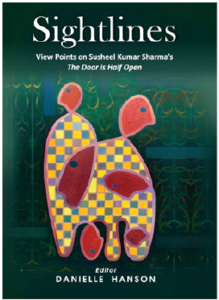
New Delhi: Paragon International Publishers, 2024, pp. xvi + 359, HB, Price: 595, ISBN: 9789394964 259.
Reviewed by Kanchan Chakravarty
Sightlines is a compilation of essays and interviews on Prof. Susheel Kumar Sharma’s collection of poems called The Door is Half Open. Edited by Danielle Hanson, this book includes twenty reviews on Prof. Sharma’s poems and four interviews with the poet himself. The anthology features contributions from a host of academicians and scholars, each bestowing their unique take on Prof. Sharma’s The Door is Half Open. This in-depth reflection of his collection of poems reveals the poetic genius of Prof. Sharma and the wide array of themes that define his poetry. The contributors explore various aspects of Prof. Sharma’s poetic creations – such as his engagement with nature, identity, culture, spirituality and even socio political issues.
The anthology, dedicated to “Poetry and Friendship across the world”, features on its cover an oil painting titled ‘Connections’ by Lithuanian artist Luana Stebule. The artwork symbolizes the relationships Stebule developed with her surroundings, and aptly reflects how the contributors of the anthology are united in their shared exploration of Prof. Sharma’s poetry. The title ‘Sightlines’ befittingly captures the different perspectives on a single point – Prof. Sharma and his poetry – and paints a broad picture of his deep involvement with poetry. The varied viewpoints highlight not only what poetry means to Prof. Sharma but also his engagement as a poet, with humanity. They also bring to the fore his connection to India’s cultural heritage, and his critical reflection on the so-called advancements of modern times.
For the sake of reviewing the anthology, the collection of contributions is categorized according to five overarching themes that have been identified, namely Indian Cultural Heritage, Philosophical and Spiritual Musing, Social and Political Questioning, Nature and Environmental Concerns, and the Aesthetics and Poetic Craft.
Indian Cultural Heritage
All the essays of Prof. Sharma reflect his admiration and veneration for the rich cultural heritage of India. But a few essays, in particular, stand out for offering a critique of contemporary issues through the lens of Indian cultural legacy. Pragya Mishra, Rashmi Jain, Natasa Miladinovic and Wendy J. Truran demonstrate how the poet skilfully bridges the past and the present by drawing stunning parallels between mythological references and contemporary issues. In “The Door is Half Open: A Mythical Study” Rashmi Jain, for instance, points out how Prof. Sharma refers to various characters from the Ramayana and the Mahabharata to address marginalized conditions, gender inequality and the challenges modern women face. According to Miladinovic, Prof. Sharma’s ability to conjure up vivid images from Indian mythology and culture inspires deep reflections on human conditions. In her essay titled “Symbolism and Imagism of the Extraordinary”, she underscores how these imageries allow readers to engage with the complex emotions and the multilayered meanings conveyed in the poems. Truran also notes in her article the poet’s desire to goad the readers to critically ruminate over the issues that are leading to the nation’s social decay and declining moral values. She writes that by drawing on Indian cultural symbols, Prof. Sharma creates a poetic landscape that is both reflective and critical: “He (Prof. Sharma) uses the stories and rituals of Hinduism and Buddhism in his poetry to question the orthodoxies of thought” (261).
Philosophical and Spiritual Musing
Reflections on philosophy and spirituality are central to Prof. Sharma’s work. Several contributions examine this dimension in his poems and show how he uses poetry as a medium to explore and critique the state of the world and humanity’s place within it. Savitri Tripathi underlines Prof. Sharma’s profound respect and admiration for ancient Indian wisdom and tradition in her essay. She writes that he sincerely believes that these resources hold the key to solving our problems. In their essay titled “Susheel Kumar Sharma’s The Door is Half Open: A Sojourn of Collective Consciousness”, Binod Mishra and Rangnath Thakur draw attention to Prof. Sharma’s search for existential meanings. While their work brings to the fore the poet’s concern for the moral and spiritual decline of humanity, Syed Ahmad Raza Abidi’s work beautifully sums up the raison d’être of Prof. Sharma’s philosophical and spiritual musings. He writes that “the estrangement felt by Prof. Sharma due to the fatigue and ennui caused by the complex modern lifestyle takes him to the edge of the living experience and hence the urgency or the soul’s deep craving for spiritual awakening” (258).
Social and Political Questioning
The contributions of Rabindra Kumar Verma and N. S. R. Ayengar emphasize the political and social concerns in the poems featured in The Door is Half Open. Prof. Sharma’s stand for social justice and the despair at the degradation of values take centre stage in N. S. R. Ayengar’s essay titled “Poetry of Protest: Susheel Sharma’s The Door is Half Open.” Ayengar underlines how genuine Prof. Sharma’s concern for the miserable state of affairs is when he writes “his (the poet’s) heart cries like a helpless child entreating for mercy” (73). At the same time, Ayengar also marvels at the poet’s bravery “to disturb the somnolence of the world around him by pointing at their failings with little care for the consequential backlash” (73). A different aspect of the poet’s political and social concerns is brought to prominence in “Spiritual, Socio-Cultural and Political Consciousness in The Door is Half Open.” In this essay, Verma writes that the poet perceives the holy river Ganga as an embodiment of equity and righteousness: “The Ganges celebrates the democratic, pluralistic and philanthropic character of the Hindu society; she does not discriminate on the basis of one’s class, social, political and economic status, caste, creed, educational background etc.” (177).
Nature and Environmental Concerns
Many of the essays are centred on Prof. Sharma’s appreciation of nature and his deep concern with environmental issues. The essays of Kalikinkar Pattanayak, Mary Mohanty and Om Dwivedi and Navya Aravind Karalingannavar are perfect examples of this type of study. Pattanayak refers to Prof. Sharma as “an instinctive green activist” who criticizes modern society’s disregard for environmental sustainability and the exploitation of natural resources (33). Pattanayak also reveals that “if Sharma gets suffocated because of corruption, pollution and degeneration of human environment, it is due to hollowness, a metaphor for thoughtlessness of modern men” (48). Being an “apostle of environmental harmony”, Prof. Sharma “opposes environmental pollution for the sake of industrialization, urbanization or modernization” (47). Mohanty focuses her essay on Prof. Sharma’s portrayal of the river Ganga as a symbol of purity and ecological degradation in “Ganga Mata – A Prayer.” She highlights how the poet bemoans the damage that pollution causes to the environment and calls for a return to respect and preservation, while highlighting the river’s cultural and spiritual significance. In “Ecological Consciousness in The Door is Half Open”, Dwivedi and Karalingannavar address the underlying spiritual bent that is discernible in Prof. Sharma’s environmental engagement. They point out that the poet urges his readers to see that the “Ganges is not just meant to be seen from a religious perspective; it provides an ecological and a spiritual perspective too” (151).
Aesthetics and Poetic Craft
Finally, a few contributions also analyse The Door is Half Open from a stylistic and formal perspective. In the essays written by Arvind Kumar Choudhary, Nikunja Kishore Das and Ranjita Barik, Prof. Sharma’s poetry is examined within the tradition of Indian English Poetry. All three contributors note that Prof. Sharma draws upon Indian mythology and classical literature to infuse his work with a strong sense of place and identity. The essays highlight how Prof. Sharma, whose poems are deeply grounded in Indian sensibilities, uses the English language to express the Indian ethos. In “Poetic Flavour of Susheel Kumar Sharma”, Choudhary, who hails Prof. Sharma as “the suitor of the cultural heraldry of India”, writes that Prof. Sharma’s “love for Indian culture is echoed here and there throughout his poetic grove” and that “Indian native words spread fragrance for the prosperity of Indian English literature” (3, 7). Das points out in his work that Prof. Sharma’s application of mythological references and Sanskrit words, firmly situates his poems within the canon of Indian English Poetry. Das’ meticulous note that Prof. Sharma used “forty– three synonyms of the Ganges, five epithets and four attributes for the river Ganges” (133) reveals the poet’s profound connection to his Indian heritage and his poetic craftsmanship in blending ancient wisdom with modern expression. The article by Barik demonstrates how Prof. Sharma incorporates Indian aesthetics into his English verses. Through the use of Indian poetics terms like dhvani (suggestion), rasa (emotional essence), Vakrokti (obliquity), Barik illustrates that Sharma, despite writing in English, aligns his work with classical Indian literary theories.
Danielle Hanson’s Sightlines is an engaging book that offers a variety of perspectives and angles that present a panoramic view into the poetic world of Prof. Sharma. The anthology, described as “a spiritual journey of a common man with Indian sensibility who wants to reclaim the past and the traditional legacy” (15) makes for a compelling read. Through essays and interviews, the anthology not only offers an in-depth exploration into themes like spirituality, Indian cultural heritage and modern societal concerns, but it also affirms Prof. Sharma’s place as a significant voice in contemporary Indian English poetry.