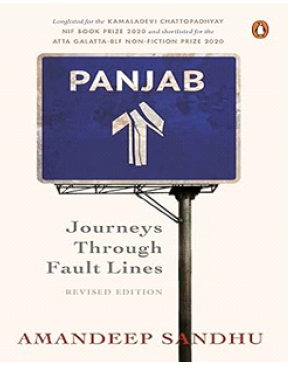
Gurugram: Penguin Books, 2022, pp. 562, Price: 599, PB, ISBN: 978-01-4345-931-6.
Reviewed by Noor Mehta
Amandeep Sandhu’s Panjab: Journeys Through the Fault Lines is a travelogue, memoir, and political commentary, yet it transcends each category to become a profound reckoning with a state too often trapped in stereotype. Written after three prolonged journeys across Punjab between 2015 and 2018, the book refuses both the romanticised image of music, mustard fields, and valour, and the reductive shadow of violence. Instead, Sandhu offers a nuanced exploration that blends intimate personal resonance with a sharp sociopolitical lens, crafting an unflinching portrait of Punjab’s fractured present.
It is a book that speaks differently to different readers. For those who have lived experience of Punjab’s villages and everyday rhythms, what Sandhu calls the “outlier state”, the narrative resonates with familiarity while also unsettling comfortable assumptions. For others, whose understanding of Punjab is limited to popular images of paranthas and lassi, vibrant bhangra, juttis and parandis, or Lohri festivities, the book functions as a corrective. It dismantles stereotypes and confronts readers with stark realities: the deepening drug crisis, the acute scarcity of clean water in the Land of the Five Rivers, and the social and political undercurrents that shape people’s lives. Sandhu examines the role of deras (socio-religious institutions) and the networks of faith, influence, and power that surround them. He revisits Punjab’s turbulent political history such as Khalistan, Operation Bluestar, and their lingering aftershocks, while also foregrounding the struggles of marginalised Dalit communities. The narrative underscores how history and politics weigh heavily upon this frontier state, leaving few aspects of life untouched. Although Sandhu writes as a Sikh, he positions himself at a critical distance, allowing him to approach Punjab’s complexities with both impartiality and empathy. He situates Punjab not as a cultural cliché or a political shorthand, but as a layered and fractured landscape of agrarian despair, caste hierarchies, drug crises, and unresolved traumas of Partition and Operation Bluestar. His account blends sharp political insight with a deeply humane sensibility, offering readers a textured and uncompromising portrait of a state that continues to wrestle with its fractured past and uncertain future.
At its heart, this is a granular, ground-up study of contemporary Punjab’s lived realities. Sandhu peels back multiple layers of crisis such as agrarian, environmental, religious, political, and psychological, revealing the complexity behind the headlines. His approach is empathetic yet critical, weaving together reportage, social analysis, and lived history. The book unfolds in thematic chapters, each centered on a major “fault line” in Punjab’s life and identity. Agrarian despair emerges as the Green Revolution’s once-lauded success turning toxic, leaving fields barren, families indebted, and suicide an all-too-common escape. Sikh trauma and identity are traced through the lingering scars of Partition, militancy, and cycles of violence that still throb in everyday life. Drug abuse, stripped of sensationalism, is revealed as a deeply human tragedy hollowing out villages and futures. Dalit assertion challenges entrenched caste hierarchies, while state violence and institutional failures erode trust. The memory of militancy, though many wish it buried, surfaces in conversations, silences, and shadows.
Sandhu’s structure resists neat linearity. Instead, he builds a palimpsest of interviews, vignettes, personal memories, and incisive political commentary. This fragmented form mirrors Punjab itself: fractured, interrupted, yet layered with resilience and memory. His dual position as both insider (by heritage) and outsider (by upbringing in Rourkela) is a critical strength. Shaped by silences and displacements, he listens without presumption, witnessing without the distortions of nostalgia or voyeurism. He does not attempt to “solve” Punjab; rather, he allows its people and landscapes to speak for themselves. As one reviewer put it, the book “reveals a land torn apart repeatedly.”
His prose balances restraint with emotion, carrying both the weight of history and the immediacy of the present. A farmer’s quiet lament, the faded murals in a gurdwara, the somber rituals in a household altered by loss, these details anchor the political in the everyday. “Silence is Punjab’s memory. Sometimes it shouts,” he observes, capturing the tension between absence and presence that runs through the narrative. The chapter on agrarian distress is especially compelling. Sandhu does not merely catalogue farmer suicides or policy failures. He probes the emotional and ecological toll of the Green Revolution. The transformation of Punjab’s soil into a chemical monoculture is mirrored by the erosion of social cohesion and intergenerational trust. He also sharply critiques the complicity of state and central governments in perpetuating false promises of prosperity, often backed by neoliberal developmental rhetoric. Sandhu’s critique of the Green Revolution is particularly incisive. Without succumbing to nostalgia, he shows how its initial promise of prosperity mutated into monoculture, debt, and chemical dependence. He pairs this with a sobering view of farmer suicides and the failure of institutional response.
Sandhu’s engagement with the trauma of the 1984 anti-Sikh violence and the militancy years is notably careful. Avoiding binaries of victim/perpetrator or patriot/separatist, he attends to what he calls Punjab’s “missing people”; not just the disappeared bodies, but the silenced memories that haunt every home and shrine. This form of what scholar Marianne Hirsch terms post-memory is central to Sandhu’s project. The chapter on Operation Blue Star is as much about the erasure of memory as it is about the event itself. The section on Punjab’s drug crisis also stands out for its nuanced resistance to sensationalism. Instead of feeding moral panic, Sandhu traces addiction to deeper structural forces: unemployment, broken kinship networks, the collapse of agricultural viability, and psychic despair. His analysis connects the state’s physical ailments to its emotional exhaustion. Sandhu resists sensationalism and instead connects it to deeper anxieties like economic, generational, and existential.
In this book, history is not something past; it is a living, fluctuating force that shapes every field, home, and conversation. The book matters not just for readers with roots in Punjab, but for anyone seeking to understand how a region’s layered histories, traumas, and resistances shape its present. For historians, policy thinkers, journalists, and general readers alike, this work serves as both record and reckoning.Ultimately, Sandhu offers neither hopeless despair nor simplistic optimism. Instead, he gives us a portrait of Punjab as it is fractured and unresolved, but stubbornly alive. In listening deeply to the land and its people, he compels us to do the same.
Crucially, the book does not flatten Punjab into a singular identity. Caste, which is so often erased in Sikh narratives, is foregrounded through encounters with Dalit activists, labourers, and Ravi Dasia leaders. These voices break open the myth of a casteless Punjab and insist on a politics of recognition and redistribution. Caste is examined not episodically but across everyday life, political mobilisation, and religious practice. His interviews with Dalit activists and residents of Punjab’s ‘chamar villages’ complicate the idea of a casteless Sikhism and reveal structural inequalities persisting beneath the surface. He documents both marginalisation and resistance, especially in relation to the Ravi Dasia assertion post-2009.
The narrative style is lucid, affective, restrained, reflective, compassionate, and marked by empathy. Sandhu avoids jargon and polemic, instead choosing storytelling as method. He allows multiple, often contradictory, voices to speak including farmers, grieving mothers, student activists, ex-militants, and Dalit poets. These testimonies, combined with Sandhu’s own moral discomfort and intellectual questioning, make the book emotionally resonant without compromising on analytical rigour. His own reflections are self-aware, often interrogating his position as a diasporic Punjabi returning with questions. This reflexivity lends the book ethical depth, distinguishing it from either journalistic quick takes or ideological tracts.
As scholars and reviewers have noted, the book’s accessibility and layered structure make it “hard to put down despite its density”. It succeeds in offering both an introduction for the uninitiated and a complex meditation for those already engaged with Punjab’s histories. The method is immersive and interdisciplinary. Sandhu draws from history, memory studies, political theory, and lived experience without naming disciplinary boundaries. The result is an account that is both testimonial and analytical.
While the book’s deep emotional involvement is a strength, some readers have noted that Sandhu’s political sympathies occasionally overpower detached critique. His alignment with grassroots voices like farmers, Dalits, and Sikh youth can at times come across as overly empathetic, leaving little space to critically interrogate their limitations or contradictions. The book’s ambition to hold multiple truths together results in a kind of narrative diffusion. Some readers may wish for a tighter argumentative arc or a clearer framework. There are also moments where the balance between personal narrative and reportage wavers slightly, though this ismore a stylistic choice than a flaw. However, his ethical stance is deliberate: Sandhu is not interested in dispassionate commentary but in restoring dignity to marginalised voices.
Moreover, while the book powerfully foregrounds caste and agrarian issues, gender remains underexplored. Women appear mainly as victims or mothers; their role as political agents especially in the post-2010 Dalit and farmer mobilisation could have been more fully engaged.
Sandhu’s work offers a powerful counter-map of Punjab, one that challenges statist cartographies and official histories while adding a distinct geopolitical dimension. Rather than viewing Punjab merely as an internal administrative unit within the Indian Union, the book reanimates it as a contested borderland, haunted by the violent afterlives of Partition, the unfinished business of federalism, and the legacies of militarisation following 1984. His treatment of Operation Blue Star, the deployment of paramilitary forces, and the silencing of dissent positions Punjab not only as a victim of internal mis-governance but as a peripheral frontier constantly managed through suspicion and force. Sandhu also exposes how Punjab’s geopolitical positioning is sandwiched between India’s national security anxieties and its ambitions of global neoliberal development, which in turn produces a contradictory reality. On one hand, the state is invoked as India’s breadbasket, vital to national food security; on the other hand, it is subject to exceptional surveillance and resource extraction. The book’s attention to water politics, cross-border identity, and the abandonment of Punjabi by central linguistic policies indirectly speaks to cultural geopolitics, where the management of space also becomes a management of memory and belonging. In this sense, Punjab: Journeys Through the Fault Lines enriches geopolitical discourse not by reproducing territorial abstractions, but by showing how geopolitics is lived, felt, and narrated by citizens. It is less about statecraft than about grounded geographies of grief, resistance, and fractured sovereignty.
Despite these minor critiques, this book is an essential work for anyone seeking to understand post-Partition Punjab beyond the clichés of either terrorism or bhangra. It is equally valuable for scholars, journalists, and activists. Sandhu’s refusal to offer easy answers, his commitment to listening, and his attempt to hold complexity without paralysis make this book a landmark in contemporary Indian nonfiction. It stands alongside the critical nonfiction of P. Sainath, Arundhati Roy, and Hartosh Singh Bal in exposing the fault lines of Indian democracy not as abstract crises but as everyday lived realities and in its shared commitment to listening across lines of pain and politics. It affirms that Punjabiyat, though fractured, still survives in stories, songs, and resistance.
This is not just a book about Punjab. It is a conversation with Punjab, one that confronts silence, listens with care, and refuses to look away. It demands the same from its readers. For readers in the diaspora, it offers a long-overdue confrontation with inherited silences. For scholars, journalists, and students, it provides a rich methodological and narrative model for regional studies. For policymakers and political actors, it is a reminder that technocratic solutions cannot resolve what are fundamentally crises of dignity and memory.
Sandhu himself writes, “The real story of Punjab is not about militancy or drugs alone, it is about the erosion of care.” This book, in many ways, is an act of care: for a land, its people, and its fractured dreams.