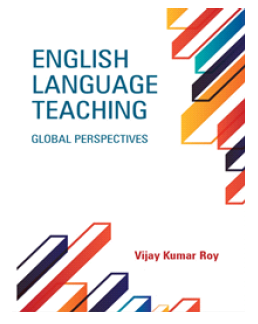
New Delhi: Paragon International Publishers, 2025, HB, pp. xvi + 215, Price: 895, ISBN: 978-93-94964-37-2.
Reviewed by Pradeep Kumar
As English language covers almost every sector, be it education, technology, politics, defense, it becomes necessary to look at this language not only as a language but a means of better opportunity and global reach. The latest published book on ELT entitled English Language Teaching: Global Perspectives, edited by Prof. Vijay Kumar Roy, is a genuine contribution to English Language Teaching from a global perspective. This book covers the important areas of English language with new insights that are useful for the researchers and practitioners of English language. The book brings together contributions from leading scholars to explore the various aspects of English language. Prof. Roy is known for his critical insights and a deep knowledge of language and literature which is reflected in his works like English Language Teaching: New Approaches and Methods (2013) and Teaching of English: New Dimensions (2012). Apart from a number of books on poetry, criticism, and language, he is also the editor-in-chief of two reputed journals: Ars Artium(https://www.arsartiumjournal.org/) and Akshara(https://www.waoar.org/journals-2/akshara/).
English Language Teaching: Global Perspectives contains 15 scholarly articles from the English language practitioners of India, Canada, Bangladesh, Saudi Arabia, Nepal, Iran, and the USA, who have shown their keen interest in English language and shared their views from different approaches. The editor has very well incorporated an extensive introduction by Prof. Prabha Jerrybandan that explains the purpose and fruitfulness of the book. Out of fifteen scholarly articles, four contributors have adopted linguistic approach, five contributors have used pedagogy and learner-centered approach, four have used global approach, and two contributors have used Gender and Ethnography study with regard to English language. The editor and one of the contributors of the book Prof. Roy’s introductory article “India and Bharat: A Study of the English Language” is a sociolinguistic analysis of the language in Indian social context. In the same way, Alireza Faramarzi and Kamran Janfeshan also use Ecolinguistic approach to investigate Iranian High School English Textbooks. Gopal Prasad Pandey’s article “Teacher Professionalism: Lemonade for English Teachers” and Abdalrahman Mansour’s article “The Extent of Incorporating Learner-centered Activities in the Intermediate Stage English Textbooks in the Kingdom of Saudi Arabia” are examples of the study which aims to adopt English language in the school system. Afroza Akhter Tina in her article throws light on the impact of the use of English language on Bengali language among teachers and students in a university in Bangladesh. Her research focuses on the codemixing process and its impact on both the languages. The editor has given the importance of quality research and that’s why he has included four articles of a single author.
“Developing English Vocabulary of EFL Learners in Elementary Institute in Iran by Improving Long Term Memory” is a case-study based research by Saheleh Kheirabadi in which she investigates the link between long term memory and language skill development. Gopal Prasad Pandey propounds the importance of ethnography as a research method in his article “Ethnography Research in English Language Teaching: Methods, Methodologies and Practical Applications.” He outlines a research model for ethnography in language education. Amar Nath Kumar highlights the processes of language acquisition and language learning in his extensive research article “Language Learning versus Language Acquisition” in which he uses various language-learning theories like Behaviourist, Cognitive, Innateness and Interaction with respect to his study.
All the chapters of this book are cohesive in nature as they present a coherent study regarding English language and its multiple aspects. They prove that English language can be used as a tool for socio-political development as well as a subject for research. The book deals with traditional and emerging areas of English language study and presents the critical insights of the scholars across the globe. Some of the research articles aim at the need of the hour as mentioned in NEP 2020. For example, the contribution of the editor himself “India and Bharat: A Study of the English Language” is a latest approach to look the role of English language in a changing India that is now Bharat, which fulfils the aim of decolonizing Indian studies.
The book has a diversity of perspectives, approaches, subject-matter, and methods useful for the teachers and researchers of English. They are also major strengths of the book. The studies also posit that the interdisciplinary research is possible in the area of English language. One can use linguistics, eco-criticism, feminism, and ethnography for conducting research in English language that can be useful for college students, teachers, researchers and for the common man in the society.
In view of the above key features and relevance of the book, I strongly recommend it for the teachers, PhD research scholars and college students to go through it and get benefitted. The study will be beneficial for a deep and vast understanding of emerging areas of research in English language and the practical approaches that one may adopt while using English language on various national and international platforms.